


From Grain to Flour
After receiving the grain, spelt passes through many stages before becoming a finished product.

Step 1
Preliminary cleaning
First, straw stalks, magnetic metal parts, sand, and stones are sorted out. After preliminary cleaning, the spelt is dehulled (i.e., it is dehusked; the kernel is released from the husk).
The main elements of the dehulling process are the dehulling stones, which lie horizontally on top of each other, with the lower one stationary (bed stone) and the upper one rotating (runner stone). A special sandstone mixture is used as material. The product enters the dehulling track through the eye (conical entry). Depending on the condition, the distance between the stones is adjusted so that the kernel is not damaged. The fine adjustment is the miller's art.
Afterward, the dehulling machine sorts the following products:
- Spelt kernels
- Chaff
- Spelt in the husk (runs through the dehulling process a second time with finer settings)
Step 2
Cleaning
Now the actual mill cleaning begins. It is divided into 2 stages:
- Dry cleaning: Removing grain impurities (broken grain, shriveled grain, foreign grain, sprouted grain, pest damage, frost-damaged kernels, kernels with germ discoloration) and black impurities (weed seeds, ergot, spoiled kernels, smut balls, contaminants, and husks) using round grain separators, length graders, and table sorters.
- Surface cleaning: Surface cleaning using peeling, brushing, and scouring machines.
Only after these steps is the spelt in the hygienic condition that makes it suitable for consumption. Through these and other machines, up to 5% of the delivered quantity is separated and sorted out. Spelt cleaning is done using purely mechanical methods and is therefore environmentally friendly.
Now the spelt is sorted by weight using a light-grain separator – according to best suitability for the end products.
Before milling, the spelt is moistened (wetted) with a precisely measured, small amount of water, just enough so that the moisture only penetrates the outer bran. During milling, the bran, which has become elastic due to the moisture, thus separates better from the brittle flour core.
Step 3
Coarse grinding
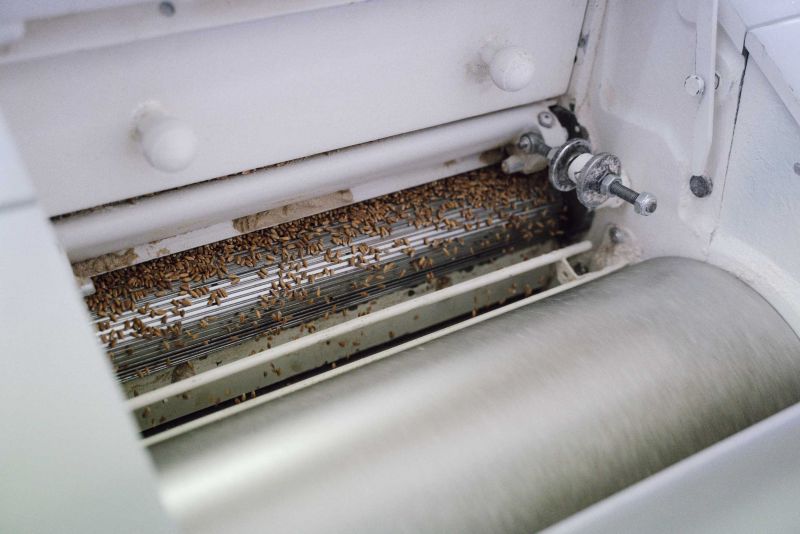
In the production of whole grain flour or whole grain meal, the kernels are ground finely for flour, or more coarsely for meal. Of crucial importance for the quality of whole grain flour is that the bran parts are also finely ground and contained in the whole grain flour, since only then can one speak of a whole grain flour.
For all other types of flour, milling spelt is an extensive process in several stages. The grain is coarsely ground on so-called roller mills. In these, large, fluted rollers run against each other, cutting or breaking open the grain.
This ground material is then sorted and sifted according to particle size in a plansifter, a cabinet-sized, rotating box with many stacked sieves inside.
Step 4
Sifting
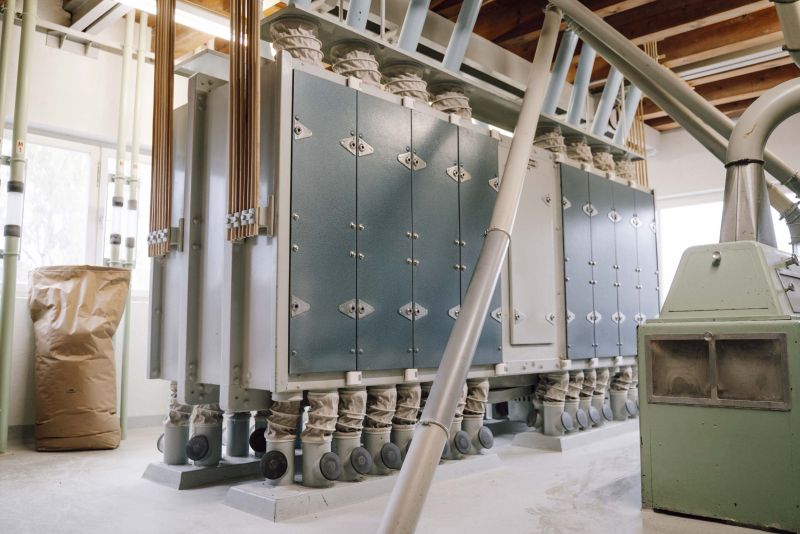
When sifting the ground material, the following components of the spelt are obtained:
- Large bran particles: with adhering flour, which are then further milled by more finely fluted rollers.
- Flours: Initially light, with increasing milling processes progressively darker flours, which are transported to the respective flour silos.
- Semolina: This is what we call the large parts of the flour core, to which bran often still adheres. The semolina particles must be separated from the bran particles that are partly still adhering and partly in between. Since these are lighter than semolina, this can be done by sifting in an air stream in the so-called semolina purifier.
- Bran.
The grinding of semolina and middlings is done on smooth rollers. The milling and sifting in the plansifter is repeated until no part of the white flour core still adheres to the bran and thus only the bran remains.
Our Focus
Energy generation
Our hydropower enables us to operate an environmentally friendly mill. We cover our entire electricity needs from our own turbine system!