


Our History
The Stadtmühle with its mill weir was built by the serfs of the Lords of Wartenberg as part of their compulsory labor service.

1139
Documentary mention under the princely rule of the Lords of Wartenberg.
1234
Mill Rights
The establishment of a grain mill required ownership of both riverbanks and was regulated by the mill regalia. Mill regalia (from iura regalia = royal rights, regalia) referred to a sovereign right belonging to the sovereign or feudal lord regarding the construction and maintenance of water mills as well as their use – mill rights.
The feudal lord was simultaneously holder of the so-called mill monopoly right, which enabled him to prohibit the construction of additional mills within a certain radius, thus creating a territorial monopoly. Furthermore, through the so-called grinding obligation or mill compulsion, he could require subjects to have their grain ground exclusively at the feudal lord's mill, which represented a compulsory use.
For the grinding of flour, the subjects paid the feudal lord a milling fee in kind, that is, by having to surrender part of the ground material to him. Additionally, the mill's feudal lord received from the miller, who had received the mill as a fief, a feudal rent in the form of money or payments in kind, typically ground grain, but also other goods.
1333
"Mill at Weiler"
On March 16, 1333, the "Mill at Weiler" was mentioned for the first time. Located outside the city at its present location, it stood at the center of a settlement.
On that day, together with his two sons Johann and Heinrich and their uncle Werner von Zimmern, Count Heinrich von Fürstenberg pledged an annuity* of ten bushels* of grain* "Nidingen measure of annual dues from our mill at Weiler, which is located on the Danube above the town of Geisingen" for a debt amounting to ten marks of silver.
1587
A document from May 26, 1587, states that the miller Caspar Landthere had died. Count Heinrich then bought back the mill from the heirs for 1,200 guilders. On June 3, 1589, he gave the repurchased mill to his daughter Anna Maria as a gift. From then on, the inhabitants of Geisingen, Zimmern, Gutmadingen, and the residents of Wartenberg were permitted to go to the Weiler Mill for grinding, dehulling, and fulling. As early as 1583, the count had also given the mill in Pfohren to his daughter as a gift. The residents of Pfohren, Hochemmingen, Balingen, Gutmadingen, and Wartenberg had been bound to it.
1692
Receipt of a Lease Contract
In 1692, the miller Günter Limperger received a lease contract for the Geisingen Mill. From it, we learn that the mill comprised five milling sections and a dehulling mill. During the last French invasion, all the mill equipment had been smashed and carried away, as is recorded in this context. It is further reported: "Item, in the above plundering, not only this occurred, but the miller with wife and child and servants was driven out, badly treated, and everything that was present was lost."
1751
The Geisingen Mill is granted to Anton Stuckle
On May 22, 1751, Anton Stuckle and his wife received the Geisingen Mill as a renewable fief*. In addition to a fourfold pigsty, the mill meadow, and several man-mowings* of additional meadows, grazing rights in the Rotlaube, in the Burgwasen, and in the Bannhölzle belonged to the renewable fief mill. The miller grazed the mill island and a pasture on the Kötach alternately with the town of Geisingen. 60 measures of grain* and 100 measures of mill produce, together with 20 guilders for a pig, were the annual lease payment that Stuckle had to pay. Geisingen, Gutmadingen, and Zimmern were bound to the mill. Stuckle held the mill until his death in 1785. Stephan Stuckle, a son, succeeded him until he too died in 1805. Upon Stephan Stuckle's death, the communities bound to the mill submitted a petition to abolish their mill compulsion, but their request was unsuccessful.
1828
Transfer as a Hereditary Fief Mill
Alois Kreuzer was a tenant for a period of 20 years. When the lease expired in 1828, he intended to purchase the Stadtmühle. It was transferred to him as a hereditary fief mill* for the sum of 12,000 guilders. He received the inventory as his property. He had to pay 24 measures of grain* according to the Fürstenberg measure as feudal rent.
1829
Abolition of Mill Compulsion
On December 1, 1829, the town again requested exemption from the mill monopoly. This time the petition was granted. However, they were still not allowed to go to non-Fürstenberg mills. Anyone who bought grain in Geisingen or Wartenberg that was intended for trade had to have it dehulled at the Geisingen Mill.
After the death of Alois Kreuzer in 1839, first his son Franz Kreuzer (1841-1875) and later his grandson Karl Kreuzer (1875-1877) took over the mill. Karl Kreuzer sold it with all rights and existing obligations to Julius Keller. The miller couple Keller operated the Stadtmühle until the death of Julius Keller in 1893.
1829
December 29, 1829, the mill received the status of a hereditary fief mill and Kreuzer paid 50 guilders as an entry fee*. He received the inventory as his property. He had to pay 24 measures of grain* according to the Fürstenberg measure as feudal rent. At that time, only Geisingen was still obligated to patronize the mill.
1895-1927
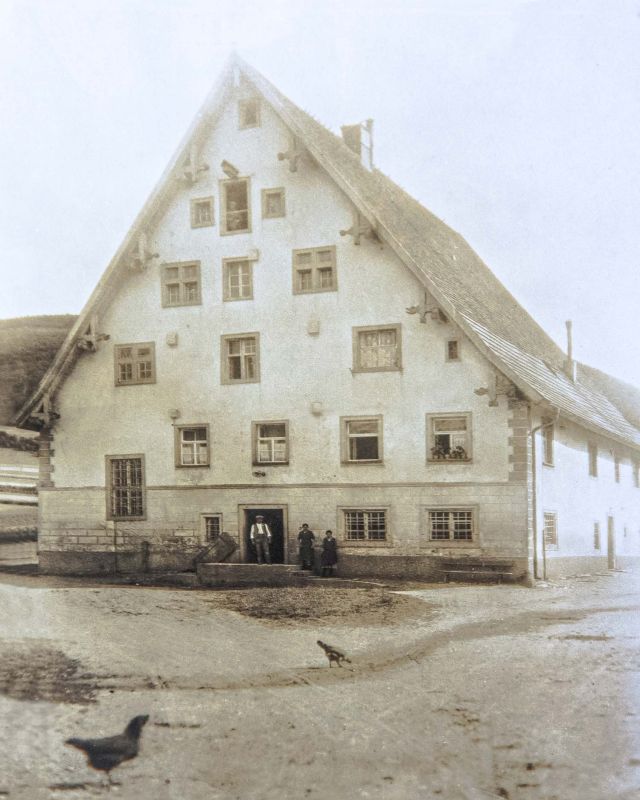
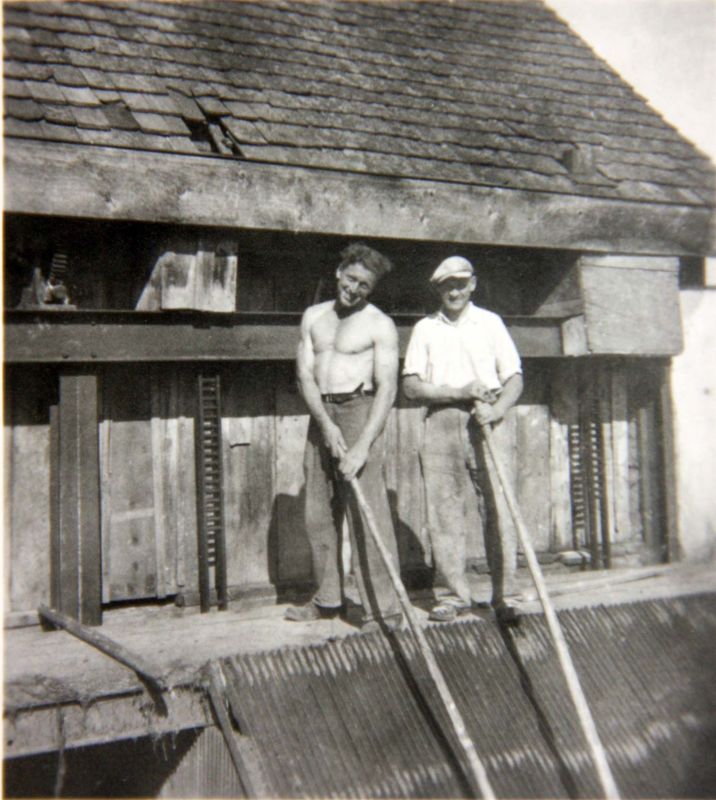
The widow Antonie Keller married the miller Vinzens Bühler from Geisingen in 1885. They took over the mill from 1895-1927. During this time, the mill was modernized, the water wheel was removed, and a turbine system was installed, which generated not only power for the mill but also electricity for its own lighting. Vinzens Bühler sold the Stadtmühle to his nephew Karl Bühler, a miller from Neudingen.
1927-1957
From 1927-1957, Karl Bühler operated the mill with his wife Emma. Their daughter Brunhilde passed her journeyman examination as a miller in 1948.
1957
On January 1, 1957, the mill was taken over by son-in-law Egon Binz, a master miller from the mill in Sunthausen. From 1957-1996, Egon and Brunhilde Binz operated the mill.
1967
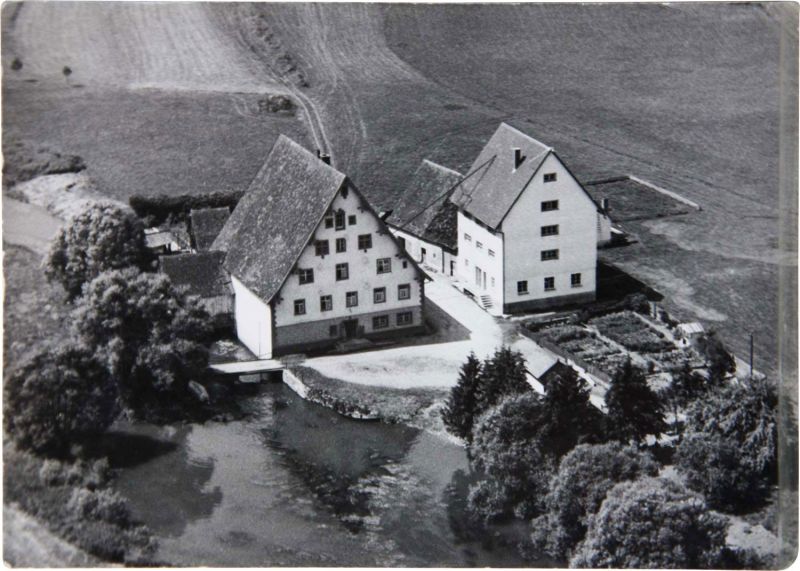
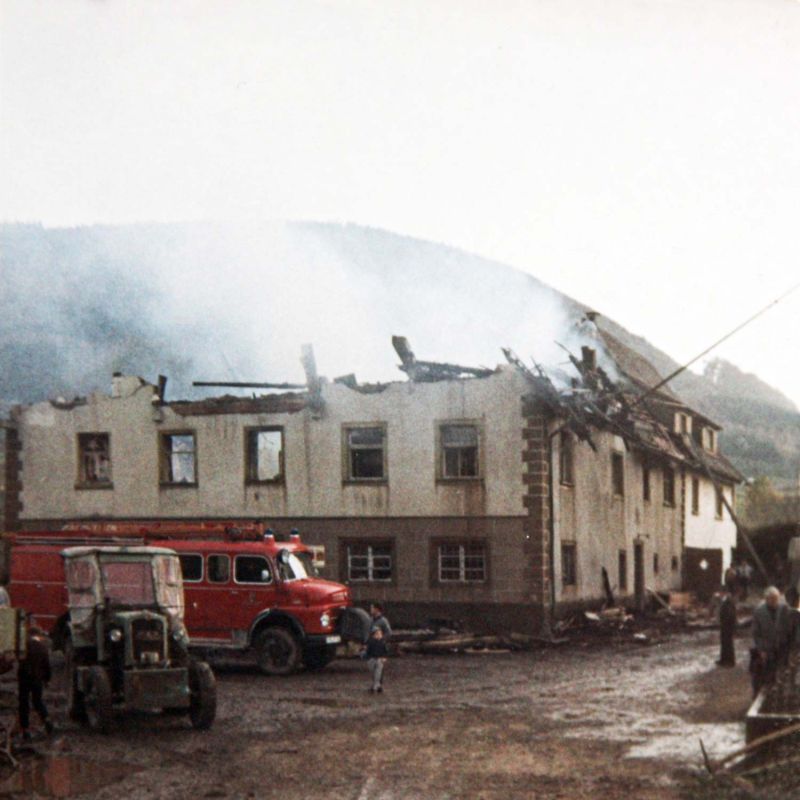
In 1967, the listed mill building fell victim to flames due to a cigarette butt and was rebuilt starting in 1968.
1996
Egon and Brunhilde Binz handed over the business to their son Karl-Egon Binz. Since that time, he has operated the mill together with his wife Regine Binz.
1997
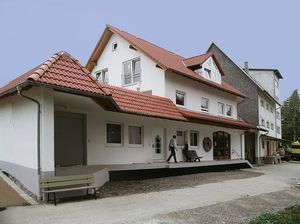
Construction of a new building for the bakery workshop, shop, office, and warehouse.
2006
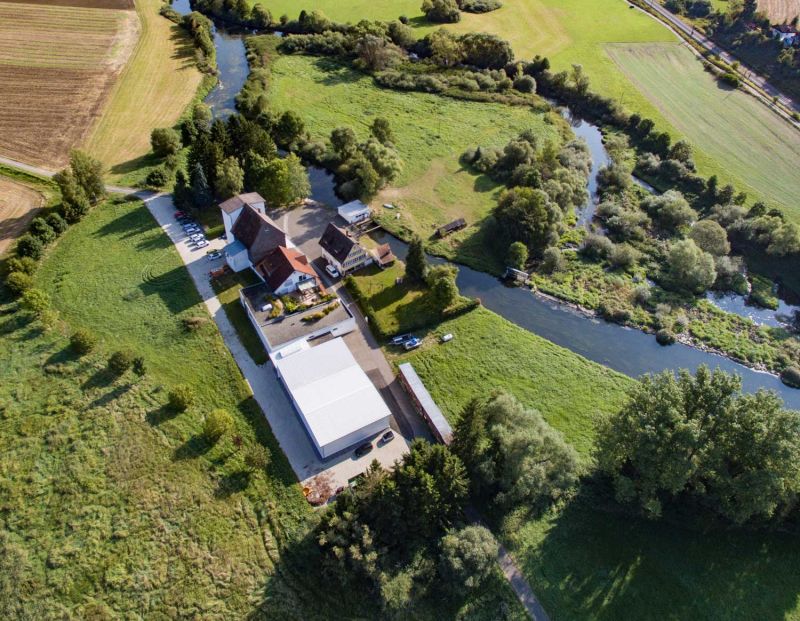
Building extensions for bakery and shipping.
2022
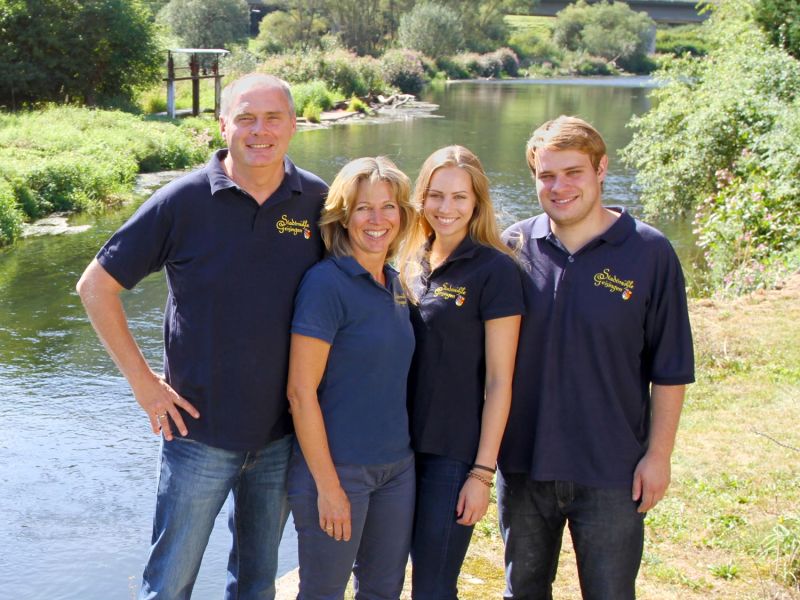
Florian Binz becomes part of the management.
2022
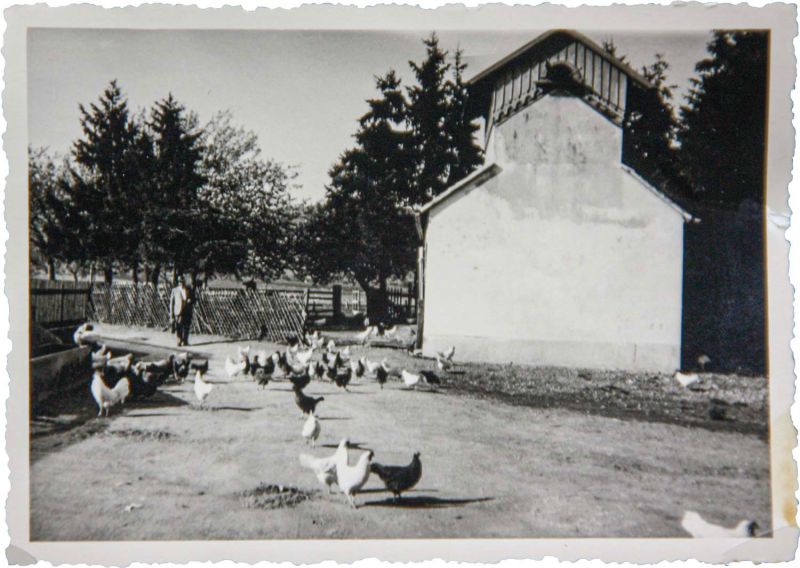
On September 18, 2022, the Mill and Hildegard of Bingen Museum was opened.
What the words mean
This chronicle quotes from charters. Here are the terms marked with an asterisk in the text.
- Annuity (Gült)
- A permanent annual due charged on a property, paid in money or in grain — much like a modern land charge, except that it fell due every year. It could be sold, pledged and inherited without the mill itself changing hands.
- Bushel (Scheffel)
- An old measure for grain. Every territory set its own size, and surviving values range from about 17 to over 300 litres. That is why the charter of 1333 states which standard applies. (The English bushel is a fixed quantity; the Scheffel never was.)
- Grain (Kernen)
- Spelt with its tightly attached husk removed — the clean kernel. In south-west Germany hulled spelt was for centuries the main bread grain and the standard commodity for paying dues; spelt still in the husk was called Fesen. It is the same raw material we sell today as spelt kernels.
- Fief (Schupflehen)
- A holding granted for the tenant’s lifetime only: on his death the mill fell back to the lord and the children were “pushed out” — hence the German name. Its opposite is the heritable Erblehen.
- Mill (Erblehenmühle)
- A mill held by heritable right: the miller could pass it to his children, but still owed the annual feudal rent. For the family it was the step from tenancy to secure possession.
- Fee (Erschatz)
- A one-off fee due whenever a holding changed hands — the transfer duty of feudal law, in Latin laudemium.
- Man-mowing (Mannsmahd)
- An old measure of meadow: as much grass as one man could scythe in a day, roughly a third to half a hectare depending on the region.