


Handed down through history
In the Hildegard kitchen as tradition has handed it down, nobody counts calories or vitamins: Hildegard von Bingen assigned every food its place. This page gathers what has been passed down – from the pantry to two recipes for everyday life and the fasting season.
The Pantry
Plenty of ancient spelt, cooked fruit and vegetables, a mindful approach to fat and animal products – this is how tradition describes Hildegard’s kitchen. Six panels show what she recommended and what she advised against.
-
Traditionally recommended
Spelt
In the Hildegard kitchen handed down to us, all spelt products come first: Habermus, spelt kernels (kernotto), flakes, flour, semolina, pasta, spaetzle, micro-milled spelt for infants, spelt coffee and spelt beer.
-
Traditionally recommended
Fruit
Apples, pears (without pear cooking water), quinces, cherries, currants, blackberries, raspberries, mulberries, cornelian cherries, rose hips, medlars, dates, almonds, walnuts, lemons, oranges.
-
Traditionally recommended
Vegetables and salad
Fennel, sweet chestnuts, beans, celery, beetroot, carrots, parsnips, chickpeas, pumpkin, garlic, onions, radish and horseradish, asparagus, salsify, Jerusalem artichoke, spinach, Swiss chard, peas, courgettes.
As salad: lettuce with spelt grains, iceberg lettuce, lollo rosso, lamb’s lettuce.
-
Traditionally recommended
Meat and fish
Poultry and turkey, ostrich, pheasant, lamb, goat, venison and deer.
For fish: pike, char, whitefish, brown and rainbow trout, perch, cod and haddock.
-
Traditionally recommended
Soured milk products
Organic yoghurt, kefir, buttermilk, soft cheese, quark, cottage cheese, Camembert, cream cheese (for the “stout”), hard cheese, Swiss cheese (for the “lean”). The traditional list names only plain, natural soured milk products.
-
Traditionally advised against
What stays off the table
Hildegard advised against strawberries, peaches, damsons and plums, and against leek; the Hildegard literature also counts nightshade vegetables among the so-called “kitchen poisons”.
Raw food, too, has no place at the table in her teaching: no fresh-grain porridge, no muesli, no sprouted seeds, no unripe spelt grain, no seedlings.
Spelt is the best grain, it has a warming and fattening effect, is high quality and milder than all other grains. Whoever eats spelt builds good flesh. Spelt leads to proper blood, gives a relaxed mind and the gift of cheerfulness. However you eat spelt prepared – one way or another – as bread or cooked as another dish, spelt is in a word good and easily digestible.”
We relate this quotation as a historical source. It describes Hildegard’s view of the world – it is not a statement about the effects of our products.
In everything man should maintain moderation in all that he does... For if moderation is observed in all things, it will go well with man in body and soul.”
We relate this quotation as a historical source. It describes Hildegard’s view of the world – it is not a statement about the effects of our products.
Kitchen and Moderation
The basics
-
Salt
According to the tradition, no meal should go without salt: “salt is very warm... and useful for many things. Whoever eats food without salt becomes weak inside.” Make sure it is of good quality.
-
Wine vinegar
Handed down from Hildegard: “Suitable as an addition to all foods, provided it does not overpower the taste. It cleanses the foul-smelling (flatulence and gases), reduces bad humors, and ensures the right digestive path.”
-
Fats and oils
Butter, cold-pressed sunflower oil, pumpkin seed oil, walnut oil, almond oil, coconut oil – not to be confused with palm oil.
-
Drinks
Tradition prefers safe tap water to mineral water (mineral water can cause “mucus buildup”). Alongside it: teas – fennel, green blends, lemon balm, nettle, sage, lavender – spelt beer and diluted wine, best drunk with meals.
The spice drawer
-
Bertram (pellitory)
In the Hildegard kitchen handed down to us, bertram is added to many dishes.
-
Wild thyme (quendel)
Wild thyme, too, is one of the traditional spices of the Hildegard kitchen.
-
Galangal
The pungent root from the ginger family – it counts as one of the universal spices of the Hildegard kitchen.
-
Pennyroyal
Pennyroyal, too, is counted among the universal spices of the Hildegard kitchen.
When man eats and drinks, then a living conduction system (vitalis tractus rationalitis) established within man directs (ducit) the flavoring substance and the fine juice and the fragrance thereof to the brain and promotes its warming (blood circulation, oxygen metabolism) by replenishing its vascular warmth... and heart, liver, and lungs also absorb something of this flavoring substance, fine substance, and fragrance into their vascular spaces, so that they are filled, >incubated< and nourished with it, like an old, dried-up intestine when you put it in water, becoming soft and full ...”
We relate these quotations as historical sources. They describe Hildegard’s view of the world – they are not a statement about the effects of our products.
Two Recipes
Two classics of the Hildegard kitchen as we pass them on at the mill: the warm breakfast and the fasting broth.
-
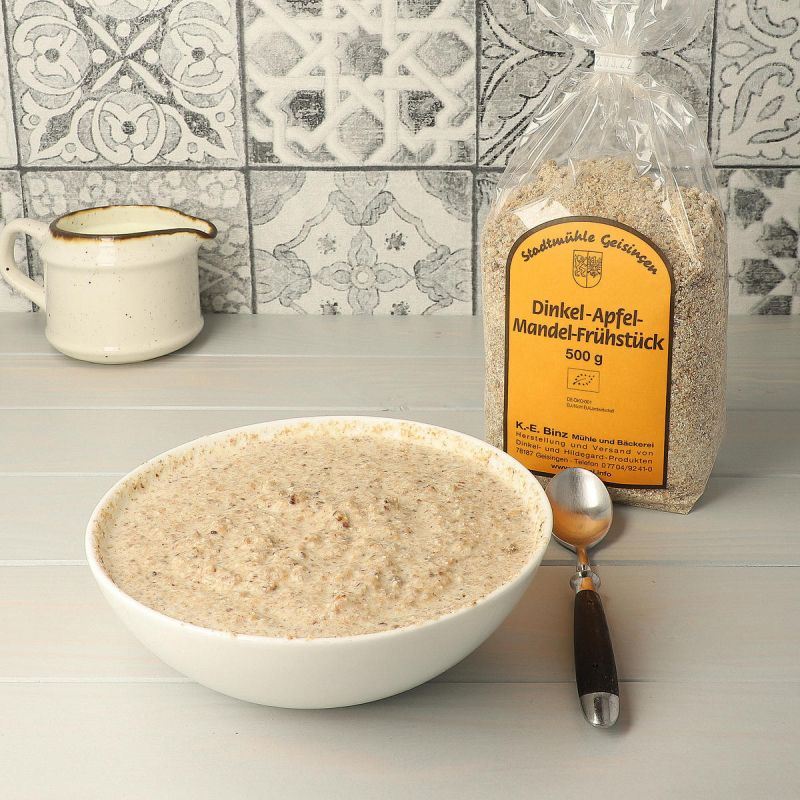
The breakfast
Habermus
Hildegard von Bingen recommended starting the day with a warm meal. The classic Habermus is quick to prepare.
Ingredients
- spelt semolina or whole spelt meal
- water
- a sweet apple
- a little honey
- slivered almonds
- bertram (pellitory), galangal and Ceylon cinnamon
Preparation
Bring the spelt to the boil with three times the amount of water and let it simmer over a low heat for about 5 to 10 minutes into a soft porridge. Stir in diced apple, spices and almonds, let it steep briefly and enjoy warm.
Tip for those in a hurry: You don’t want to weigh ingredients and mix spices yourself every morning? We have created this exact traditional Hildegard breakfast for you as a ready-made composition with fine spelt flakes, apples, almonds and real galangal – simply pour hot water or a milk-and-water mixture over it and enjoy! Available directly in our shop: Spelt-Apple-Almond Breakfast
-
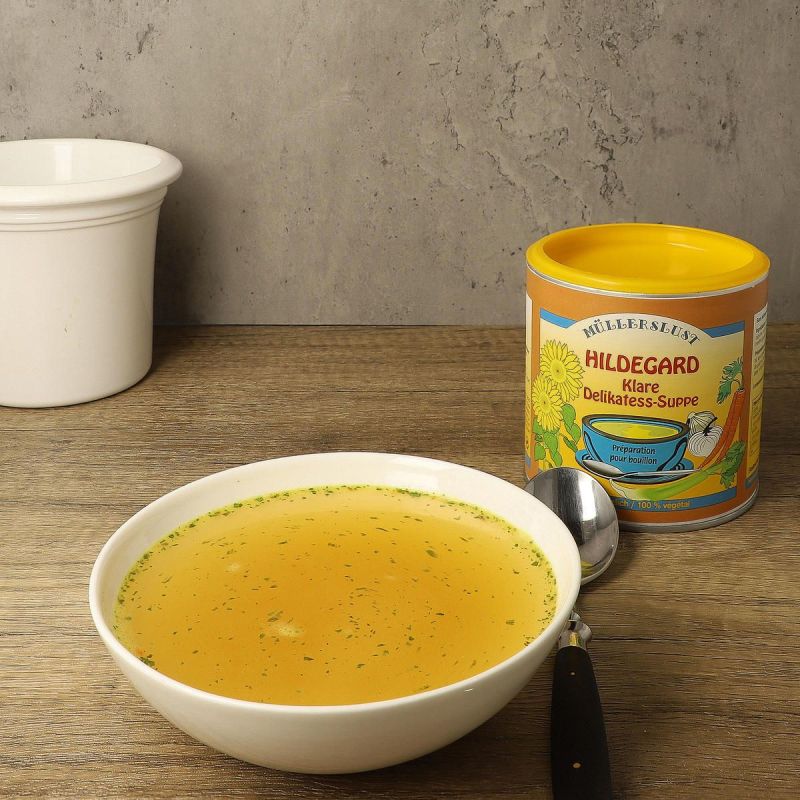
The fasting season
Spelt fasting broth
In the fasting tradition handed down from Hildegard von Bingen, there is no radical deprivation: warm food is eaten throughout. The spelt fasting broth forms the foundation.
Ingredients for two
- 1 l water
- 2 tbsp spelt semolina
- 300 g finely chopped vegetables (e.g. fennel, green beans, carrots, celery, parsley root)
- chopped herbs (parsley, mugwort, ground ivy, lovage)
- bertram (pellitory), galangal, nutmeg
- 1 pinch of salt
Preparation
Steam the vegetables in an open pot with a little water and puree them. Bring the spelt semolina to the boil in 1 l of water for 5 minutes, add the pureed vegetables and bring briefly back to the boil. Season with the herbs and spices and adjust with a pinch of salt.
Tip for fasting practice & those in a hurry: Freshly chopping and pureeing specific Hildegard vegetables and precisely balancing the herbs often takes a lot of time in everyday life. We have developed the Hildegard Clear Delicacy Soup as an ideal, quick base for your fasting days or as a fine seasoning between meals.
This purely plant-based (vegan), lactose-free and gluten-free granulated broth strictly follows the original teachings: it is deliberately made without yeast, sugar, leeks or cabbage and contains the original Hildegard herbs such as galangal, pellitory (bertram), pennyroyal and mugwort. Perfectly rounded off with rock salt and sunflower oil – simply pour over and enjoy!
Packaging unit: 400 g pack, makes approx. 80 plates · available directly in our shop: Hildegard Clear Delicacy Soup
There are also people whose heart, liver, lungs, and other energy providers with their warmth do not sufficiently help the stomach with final digestion when these people consume raw and uncooked or fatty foods, especially if these are too fatty, heavy, or too hard.”
Good to know
What has come down to us from Hildegard von Bingen is a historical source — not a medical statement. Our pages and products pass this tradition on; they are no substitute for medical advice.
Recommendations from our range
A selection related to the Hildegard kitchen – books, spelt, spices and soups. The books are German-language editions.


